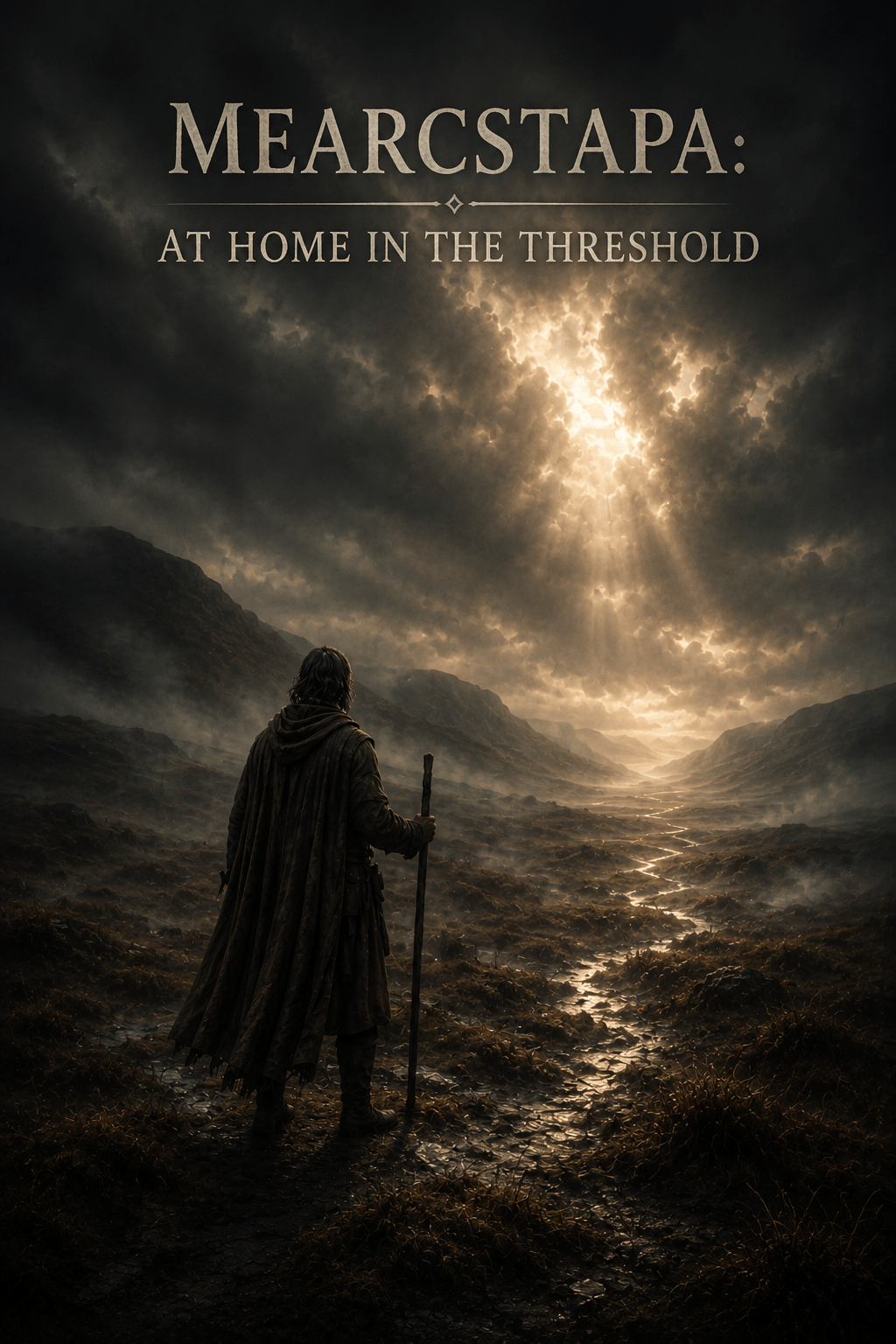
I recently came across the word ‘Mearcstapa’, and like the song Pink Pony Club, I am having trouble getting it out of my head.
Mearcstapa (often translated as “border-stalker” or “mark-stepper”) is an Old English compound noun in Beowulf used to describe the monster Grendel, and later his mother, as they haunt the moors, fens, and forbidden wild spaces bordering human society. The term defines them as liminal beings, existing on the edges of civilization.
Mearc means “mark,” “border,” or “boundary,” while stapa means “stepper” or “walker”. A mearcstapa is one who stalks or walks the boundary lines.
The term emphasizes that Grendel exists between spaces, neither fully inside human society nor completely removed, but threatening the edge.
Do you ever feel like you are living in a space where you are threatening the edge of society? Neither fully inside it nor completely removed from it?
Author and painter Makoto Fujimura has reinterpreted the term to describe artists or individuals who live and work “on the edge of their groups,” traversing different “tribes” or cultural divides.
Perhaps you are someone who dwells on the edges of several groups, moving in and out of them with relative ease.
Perhaps vocationally, you are a mearcstapa. You work in a profession but never quite embrace its orthodoxies. You know the language of the tribe, yet you remain suspicious of its certainties. You are close enough to belong and distant enough to question.
Perhaps you are an academic who spends more time with practitioners than scholars, or a practitioner who enjoys ideas too much to fit comfortably among practitioners. You walk the boundary between theory and application.
Perhaps you are a religious believer who has experienced enough doubt to understand skeptics, or a skeptic who cannot quite extinguish a lingering sense of wonder. You wander the borderlands between certainty and mystery.
Perhaps you are a rural person who feels at home in cities, or an urbanite who finds yourself drawn to open fields and quiet places. Neither landscape fully claims you.
Perhaps you are a parent whose children are grown. You no longer inhabit the world of young families, but you are not yet part of the generation that watches entirely from the sidelines. You stand on a threshold.
Perhaps you belong to a generation caught between worlds. Young enough to understand technology but old enough to remember life before it. You can translate between digital natives and digital immigrants because you have lived in both countries.
Perhaps you have changed politically over the years. Ideas that once felt obvious no longer do. You find yourself homeless among competing certainties, listening to arguments from both sides and finding reasons to disagree with each.
Perhaps you are someone who has experienced profound loss. You move through ordinary life, but part of you still dwells in another country, one invisible to those who have not traveled there. You stand with one foot in the world of the living and another in the world of memory.
Perhaps you are a convert, an immigrant, a veteran, a recovering addict, a former believer, a newly diagnosed patient, or a retiree. Such transitions often create border-walkers. You learn the customs of a new land while remembering the language of the old one.
The challenge of being a mearcstapa is that people on both sides may distrust you. Tribes often prefer clear loyalties. Border-walkers can appear indecisive, compromised, or suspicious because they understand more than one perspective.
Yet there is also a gift in dwelling at the margins.
The people at the center of a tribe see the world through a single set of assumptions. Those at the boundary can see multiple worlds at once. They become translators, bridge-builders, and guides. They notice what insiders overlook and what outsiders misunderstand.
Grendel was a monster because he threatened the boundary. But Fujimura’s reimagining suggests another possibility: not every border-stalker is a monster. Some are peacemakers. Some are artists. Some are prophets.
Perhaps the people most needed in a fractured age are not those standing confidently at the center of their camps, but those willing to walk the edges, listening across the divide.
Perhaps the mearcstapa is not merely a creature of the wilderness.
Perhaps it is anyone who has learned to make a home in the threshold.


Leave a Reply