The Spectrum Unfolded
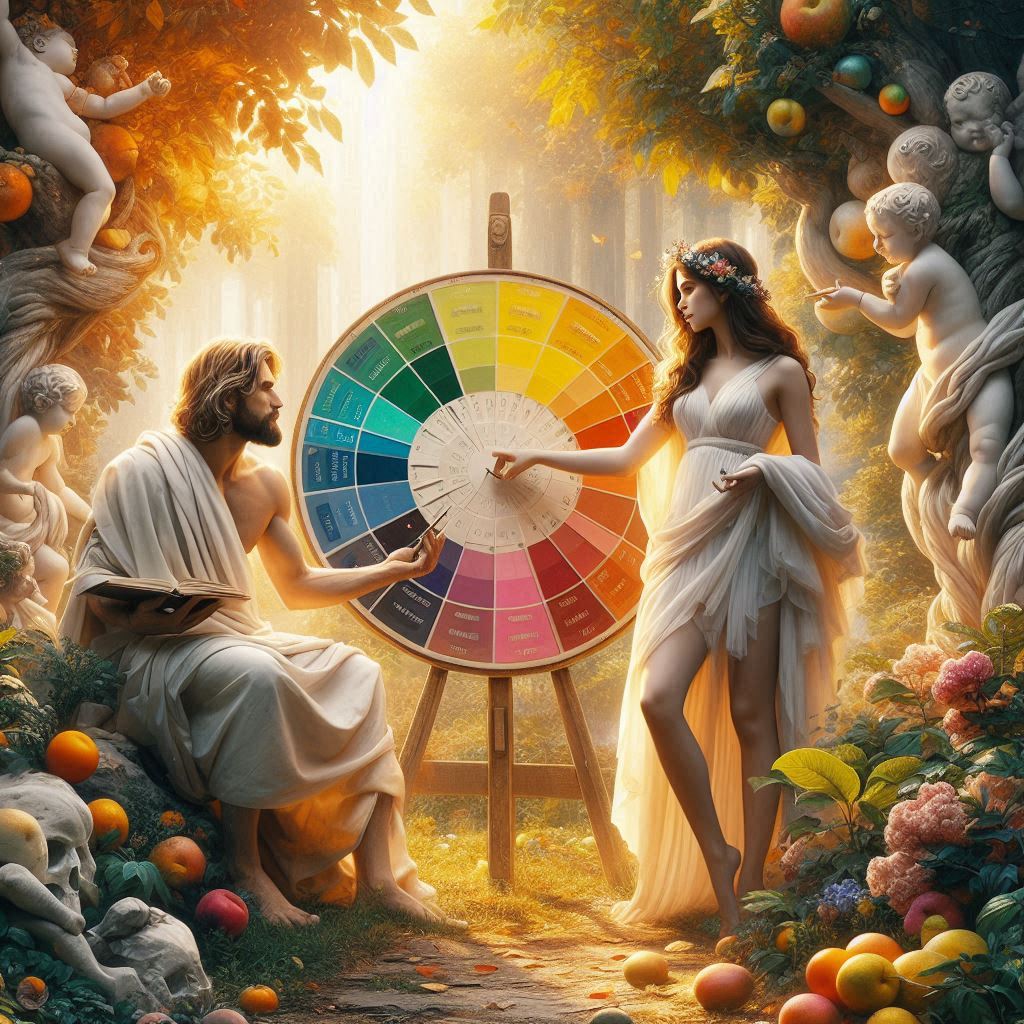
As the first light of dawn broke over Eden, Adam and Eve found themselves marveling at the rich tapestry of colors that painted their world. With green, blue, and red named, they turned their attention to the remaining hues that caught their eye.
The morning sun cast a golden glow across the garden, illuminating a patch of delicate flowers. “Look,” Eve said, pointing to the vibrant blooms. “These are neither red nor green, but something in between.”
Adam nodded, his gaze drawn to a peculiar fruit hanging from a nearby tree. “And this,” he added, plucking the round object, “it’s similar to the flowers, but somehow… different.”
As they examined the fruit, the serpent slithered into view, its eyes glinting with curiosity. “Ah, yesss,” it hissed. “The sun-kissed hue of cowardice.”
Eve frowned. “Cowardice? But it looks so cheerful and bright.”
The serpent’s tongue flicked out, tasting the air. “Watch how it pales in comparison to the bold red, how it shrinks from the intensity of other colors. Is that not the very essence of fear and weakness?”
Before Adam could respond, God’s presence enveloped them like a warm breeze. “My children,” the Creator’s voice resonated, “remember to consider all aspects. The serpent speaks of one perspective, but there is more to see.”
Suddenly, Adam and Eve’s perception expanded. They saw the golden flowers not as shrinking or weak, but as symbols of joy and energy. The fruit in Adam’s hand seemed to glow with vitality and warmth.
“This sunny hue,” God continued, “represents not only caution but also happiness, wisdom, and the life-giving power of sunlight. Let us call it ‘yellow,’ a word that encompasses both its appearance and its many meanings.”
Eve nodded, understanding dawning in her eyes. “And what of this fruit?” she asked, taking it from Adam’s hand. “It’s similar to yellow, but… deeper, more vibrant.”
God’s chuckle rippled through the garden. “Ah, that is a special one. Its color is unique, much like the fruit itself. Let the fruit be called ‘orange,’ and its color shall share the same name.”
Adam and Eve laughed at the simplicity and cleverness of this naming, delighting in the sweet, tangy flavor of the orange as they shared it.
As they continued their exploration, Eve’s attention was drawn to a patch of pristine lilies. “These flowers,” she mused, “they’re unlike any color we’ve named. They seem to reflect all the light around them.”
The serpent’s voice whispered from nearby. “Yesss, the absence of color. Pure, untouched… untainted.”
God’s voice joined in, warm and approving. “Indeed, this color represents purity and innocence. Let us call it ‘white,’ a symbol of new beginnings and unblemished potential.”
Adam nodded, but then pointed to a rocky outcropping nearby. “And what of those stones? They’re neither white nor black, but something in between.”
The serpent coiled thoughtfully. “A color of uncertainty, neither one thing nor another.”
“Yes,” God affirmed, “but also a color of balance and complexity. Let us name it ‘gray,’ a hue that reminds us that not everything in creation is simply black or white, but often a mixture of both.”
As the day wore on, the first humans continued to explore and name the colors around them. But as night fell, they encountered a new challenge – the absence of color.
Darkness crept across Eden, and with it came a sense of unease. The serpent, nearly invisible in the gloom, whispered from the shadows. “Feel how the darkness consumes everything, how it hides dangers unknown. This is the color of fear, of the unknown terrors that lurk in the night.”
Adam and Eve huddled closer together, their hearts racing as they peered into the impenetrable blackness.
Once again, God’s presence surrounded them, bringing comfort. “The darkness, which we shall call ‘black,’ is indeed mysterious and can evoke fear,” the Creator acknowledged. “But it is also the color of rest, of renewal. It is in the darkness that dreams flourish and stars shine brightest. Without black, the other colors would lose their vibrancy and meaning.”
As God spoke, Adam and Eve’s eyes adjusted to the darkness. They began to see the beauty in the night sky, the twinkling stars, and the soft shadows that gave depth to their world.
With the naming of black, Adam and Eve realized their task was complete. They had given names to the colors that painted their world: the green of life, the blue of sky and water, the red of passion and vitality, the yellow of sun and joy, the whimsical orange, the pure white, the ambiguous gray, and the mysterious black of night.
As they settled down to sleep, surrounded by the gentle darkness, they reflected on their journey. Each color, they realized, was like a facet of their own existence – complex, multi-layered, capable of evoking a range of emotions and meanings.
“We’ve named the colors,” Eve mused sleepily, “but I feel we’ve learned so much more than just names.”
Adam nodded, drawing her close. “We’ve learned about balance, about seeing beyond first impressions. Each color, like each aspect of creation, has depth and purpose.”
God’s voice, soft as a lullaby, washed over them one last time. “You have done well, my children. In naming the colors, you have begun to understand the complexity of the world I have created. Remember always to look beyond the surface, to see the beauty and purpose in all things, just as you have done with the colors.”
As Adam and Eve drifted off to sleep, the garden around them seemed to pulse with newfound vibrancy. The colors, now named and understood, told the story of creation itself – a tale of light and dark, joy and sorrow, fear and courage, purity and complexity, all woven together in a magnificent, ever-changing tapestry.
And so, in the heart of Eden, the world received its true colors, each hue a testament to the rich complexity of life itself.
 certifiable
Leave a comment