If you have spent any time online over the last few years, you have seen firsthand both the wonders and the horrors of even a minimal online presence. The internet and social media have given us access and platforms that were historically reserved for a very select few or those with the resources to push their information out into the world. Before this brave new world, we find ourselves in, you had to write a book, write a letter to the editor, create a newsletter, wrangle yourself on TV/radio somehow, record an album, or stand on the steps of the courthouse or in the town square and shout your hot takes.
Nowadays you can push out any information you want to share instantaneously. You can have your own weather blog, live stream your reactions to politics in real time, share your hot takes seconds after events, share reels of your dance moves, share pics of your latest meal, or share the latest meme you found funny or thoughtful. I wouldn’t be surprised if future (or current) historians and sociologists don’t view this as a critical shift in our society.
Twenty years ago, if you went around in public showing people home videos of your latest dance moves, Polaroid pictures of your last meal, print outs of weather maps with your markings on them, or stood on the street corner shouting out your hot takes on current events, you would rightly be escorted home or taken in for evaluation. Now all these activities are perfectly normal and even encouraged to some extent.
I find it a wonderful time to be alive but there is a certain amount of fatigue that comes with this technological territory. We all have that friend or acquaintance that shares thirty plus posts a day (sometimes less is more people). That Facebook “friend” who is always talking about the next great governmental conspiracy. That Instagram brat of a kid who films himself and his friends pranking and making fun of people. That scantily clad influencer who posts provocative photos and suggests that you can see more of them if you pay them $15 a month.
Twenty years ago, we told the person handing us print outs of 30 plus memes a day to knock it off. Twenty years ago, we had a heart to heart with the person who keeps showing us his wall size flow charts and diagrams of how the government is secretly run by lizard people. Twenty years ago, someone punched that brat of a kid in the nose for making fun of people. Twenty years ago, a woman showing you Polaroid of herself in a skimpy outfit and suggesting that if you give her $15 she would let you see more probably resulted in a solicitation charge.
Sometimes I think those people who eschew the internet and social media may actually know what they are doing but I’ve personally crossed the digital Rubicon and don’t see me reversing course at this point. It used to be that you didn’t know your neighbor was such a hardcore Nickelback fan. It used to be that you didn’t realize that your co-worker wrote Twilight fan fiction. It used to be that you didn’t know the guy you go to church with follows a group online called Latex Lovers. It used to be that you didn’t know your barber was a Libtard/Socialist/Deplorable/Cultist.
I don’t think we can put the genie back in the bottle, so how do we navigate these online minefields? How can we have a digital presence and enjoy the wonders of the digital world without being caught up with other keyboard warriors, digital tit for tats, doom scrolling, and snapping out of a haze an hour later after going down an online rabbit hole? I humbly suggest the following as some possible rules that I try to follow (although I still fail at times, these online rules have helped me better enjoy my online pursuits).
- The 24-hour (possibly 48) rule.
I have learned that it is wise to wait at least 24 hours before offering a hot take on anything that is likely to be controversial. The Paris Olympics have given us at least a couple of events that have generated a lot of strong reactions and hot takes. I didn’t see the opening ceremony scenes that generated such strong reactions live so my initial impressions were shaped by those commenting on it shortly after it happened. With the 24/48 hour rule, I try to refrain commenting too much on anything for 24 to 48 hours as I have given out some bad hot takes in the past that with some time and reflection would have kept me from some of those hot takes I later found to be misguided.
We are all influenced by what we are influenced by. Sometimes those influences serve us well, but other times those influences lead us down the wrong path and we end up being wrong and posting about it for all the world to see. I still don’t know who the guy in blue was at the opening ceremonies. My influences tell me that blue skinned men are either Smurfs, blue skinned Fugates from Appalachia, or creatures from that Avatar movie. Within 24/48 hours I ultimately found out that each of those influences informing my judgment about the blue skinned guy were in the end wrong. As for the meaning of the opening ceremonies, I’ve seen people say what it was, and what it wasn’t. I don’t know what was intended. It was odd and weird to me but I’m sure whatever I would have come up with for an opening ceremony would have been viewed that way as well. The whole thing strikes me as kind of a cultural Rorschach test of sorts. We tend to see what we are primed to see or looking to see.
2. Don’t believe everything you read on the internet (The Lincoln Rule).
One of my favorite quotes from Abraham Lincoln is “Don’t believe everything you see on the Internet”. The world wide web is an amazing place but with the democratization of information sharing, the traditional gatekeepers or quality control specialists verifying the information that you encounter online may not exist or may not care. I had the experience of training and practicing as a psychologist before and after the internet came of age. As more and more people learned how to use the internet, it became increasingly more and more common that patients and/or their family members would bring in something they had seen online or scores from a test or quiz they took online that led them to believe that they had X or Y condition. On occasion what they had found was in the ballpark but most of the time what they found was nonsense or something that supported what they wanted to be supported.
I suspect the same is true of other bodies of knowledge on the internet. Just because it is online doesn’t mean it is true. I regularly see things online that just aren’t true or are not seen from their full perspective. There was a clip of President Biden last week getting on the plane in which the recently released American hostages came home. Depending on what clip, post, or commentator you saw, some said that Biden was confused and got on the plane thinking he had arrived on that plane or he was going on the plane to thank the pilots and staff that facilitated getting the hostages home. I don’t know which actually happened but many of us are gullible and will repost or share something we have no knowledge of simply because it fits the beliefs and narratives we prefer to believe.
3. Don’t live in an echo chamber.
Echo chambers refer to an environment in which a person encounters only beliefs or opinions that coincide with their own, so that their existing views are reinforced and alternative ideas are not considered. This results in a sort of tunnel vision and allows us to fall victim to confirmation bias, a psychological process of the human tendency to only seek out information that supports a given position or idea. This causes us to have a bias towards your original position because if you only seek out information that supports one idea, you will only find information that supports that idea. Jamieson and Capella in their influential book Echo Chamber defined an echo chamber as “a bounded, enclosed media space that has the potential to both magnify the messages delivered within it and insulate them from rebuttal”.
Echo chambers can easily happen to us online. It is completely natural to tend to gravitate towards those people, causes, groups, and online sources of information that resonate with you. However, we are each fallible and can easily lose sight of the forest for the trees. Exposing yourself to opposing/alternative views is a good way to protect yourself from being unduly influenced by potentially wrong information. If you are not exposing yourself to alternative viewpoints, you are at risk of being insulated from an information standpoint. I hope it is not lost on you that insulation from information is a key strategy used by people like abusers or people who seek to control you. You are much easier to control if you never encounter anything that challenges your views or the view someone wants you to have.
If you don’t believe in the power of echo chambers, after any major political story watch the analysis of that event from different news sources. Watch 15 minutes of what Fox News says about X event and then watch 15 minutes of what MSNBC says about X news event. They will likely have very different takes on the same news event. Is one right and one wrong? Or are they feeding you a given spin or take on that event. A word of warning, if they are both saying the same thing or giving the exact same analysis, then it is likely that something has happened that it is hard to argue about or spin. Otherwise, I would take what either of them says with a grain of salt, like I will take what you say if you quote either of them to me.
There are actually some great infographics that try to help people put sources of information into context with respect to potential political leanings certain sources of information may have. You can find one of them here https://adfontesmedia.com/interactive-media-bias-chart/
4. Never wrestle with a pig online.
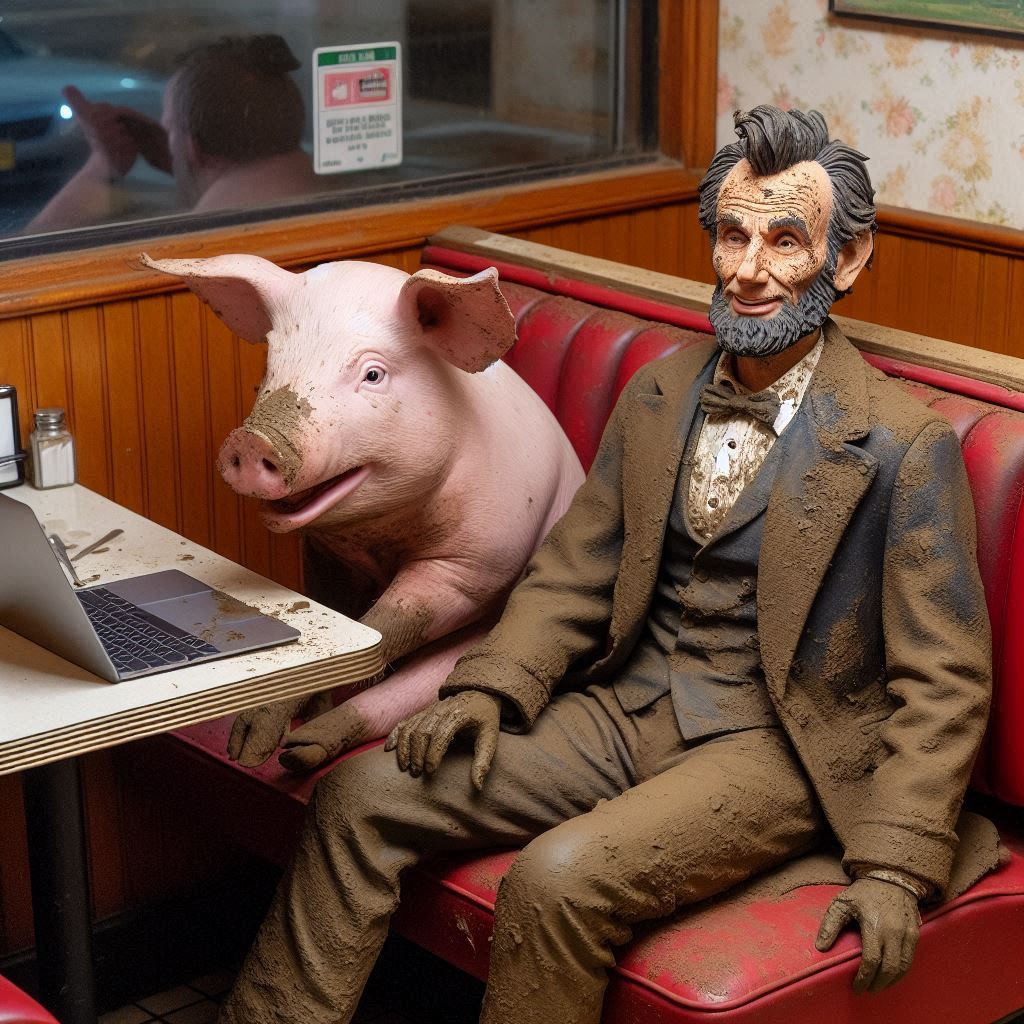
Most of us have heard the saying, “Never wrestle with a pig. You’ll just get dirty, and the pig will enjoy it”. I think this applies to online interactions from time to time. Many of us have fallen victim to some sort of online exchange in which we afterwards probably felt like the guy who tried to wrestle with a pig. If someone has posted something that evoked a reaction in you so strongly that you were compelled to respond, it is unlikely that what you respond is going to change their mind. Now sometimes, you may think that what they posted just needs to be called out or addressed. Have at it sister but if you think you are going to suddenly compel them to change their mind with your witty and well-reasoned reply, you are most likely wasting your time. If someone takes the time to post something to “own the libs” or “show the deplorables”, they are most likely a true believer and are only going to see your reply as a typical “lib” or “deplorable” response.
There are also some people among us online who are trolls, who post for attention, to get a reaction from others, or to drive traffic to their site or account. I’m a pretty cynical guy, so I’m pretty confident that a good number of these people don’t actually believe what they are sharing or posting for accuracy but realize that it is good business. If you can help from it, don’t feed or respond to the trolls.
5. Granny & Gramps is Watching
The last thing I recommend is assume that your Granny/Gramps is going to read what you say online and you will have to explain it to them at Thanksgiving dinner (if you are fortunate enough to still have your Granny). If not, pretend Granny/Gramps is watching you from beyond and is shaking their head at you spending two hours watching ASMR videos of a guy cleaning dirty rugs and engaging in online keyboard fights.
Be safe out there everyone and go touch some grass today.
 certifiable
Leave a comment