Mission Statements: Getting Personal
If you have delved any depth at all into a company or organization’s website, brochure, or annual report, you have probably at some point come across a page listing their mission statement. Sometimes there will even be vision statements and values listed as well. It seems standard nowadays for companies and organizations to have a mission statement that reportedly provides direction and guidance for the organization. Typically, organizations put some notable effort into making sure these mission statements are hung in a nice frame in their lobby, posted on their website, or placed prominently somewhere in their marketing materials.
Unfortunately, for some organizations, this is about as far as the mission statement goes in guiding the organization. Mission statements should ideally guide an organization but too many times they are just something that gets framed, posted, or printed and never read or put into practice. That is a shame as quality mission, vision, and values in an organization can simplify and streamline decision making and direction.
I’ve worked with various organizations and entities over my professional career. Some have truly embraced the value of mission, some have had a mission in name but not in practice, and others have seemed to make it up as they go along. Being part of the creation of the mission, vision, and values of an organization is an interesting process. It can be quite painful if not done well but invigorating for staff and the organization if done correctly.
There are professionals who make a living, or at least part of their living, being consultants who help organizations craft such statements. I’ve been part of this type of exercise several times and have sometimes come away impressed, sometimes vexed, and a time or two thinking I could come up with something as good as or even better than this for $1,000 a day. The best consultant I remember came in for a two-day retreat to help a healthcare organization I was affiliated with re-craft a mission statement, our vision, and our values.
During our work together, this consultant asked our group if he might be vulnerable and share his personal mission statement with us. (How rare is that! Asking permission to be vulnerable, something we typically avoid at all costs). I was impressed before he even shared his mission statement.
He had obviously crafted his mission statement after much thought, reflection, and prayer. It covered all the areas which he valued and what he aspired to in each of these areas. He had sections for family members (wife, children, grandchildren, siblings), his work (colleagues, clients, employees), his self (career, health, recreation), and his faith (God, church, mentoring). It was very inspiring but also very intimidating.
I had never really heard of someone having or using a “personal mission statement”. The idea intrigued and fascinated me. Shortly after this retreat, I was exposed to a family reunification method that used the concept of a mission statement in a different, albeit equally powerful manner. As part of the method, family members are asked to craft their own personal mission statements in an effort at reunification. Family members are asked to identify behaviors and ways of interacting with others that they need to change and others to which they would like to aspire. These are incorporated into their personal mission statements.
These experiences caused me to start thinking about what putting my own mission statement to pen and paper might look like. The idea of sitting down and writing a mission statement like either of these approaches was frankly overwhelming. It posed all kinds of difficult, thorny questions. What is it that I truly valued? How does one best approach determining what one values? How should one treat what one values?
I decided pretty quickly that I was never going to come up with anything as beautiful and detailed as our consultant had created for a personal mission statement. So, I decided I would try to make it relatively simple to remember, cover a lot of ground, and have reasonably realistic targets to which I would actually want to aspire.
After much deliberation and some tinkering over time, I have landed on the following the elements of a personal mission statement:
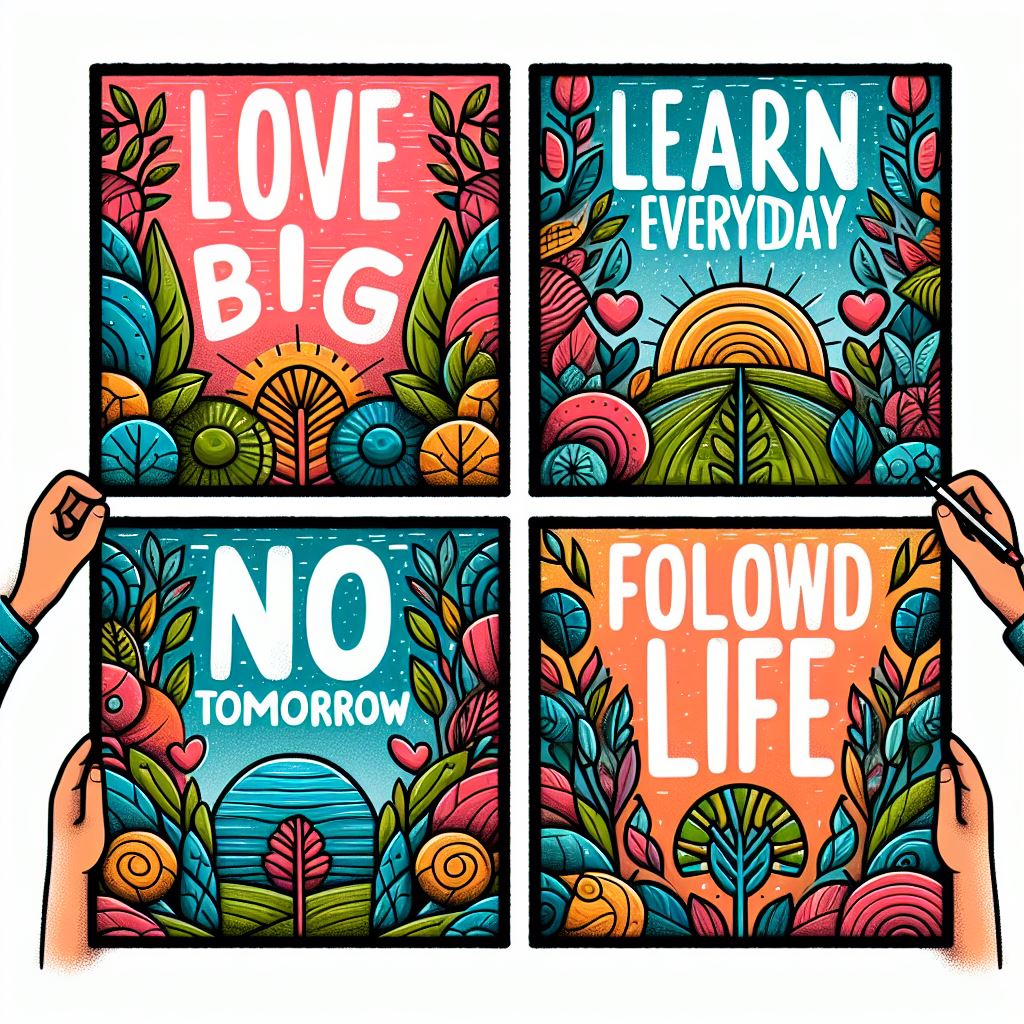
Learn something new every day.
Lead a life to be followed.
Live like there might not be a tomorrow.
Love big, even if it might be bigger than someone seems to deserve.
If at the end of each day I could say that I had learned something new, that I had led a life worth following, that I had lived that day as if there were not a tomorrow, that I had loved bigly, I think it would have to go down as a pretty good day.
Since that night, at the end of each day I try to ask myself these four questions.
- Today, did I learn something new?
- Today, did I lead a life to be followed?
- Today, did I live like there might not be a tomorrow?
- Today, did I love BIG?
I fall short many days, but I see them as aspirational goals that are worth the striving.
Live like there is no tomorrow. How would our lives be different if we all took this approach to life? I’m not talking straight out hedonism and gluttony here but embracing life and living it to the fullest; not passing up opportunities that that would make our lives fuller. How would our lives be different if we took the roads we typically don’t take?
Change where you sit at meetings; order something new off the menu; say yes when you would normally say no; call your mother (she says you don’t call enough); sing/play air drums in the car; stand out in the rain when your instinct is to run inside; jump in the puddle with your kid instead of yelling at him to get out of the puddle; hold her hand in public; be convicted of a public display of affection; say Amen, clap, or hold up holy hands in church; wave at children on the school bus; stop and pet dogs; tell the mean lady at the utility company a joke; wear outrageous underwear; trade in your regrets.
Love big or extravagantly. When was the last time you loved BIG? When was the last time someone loved you extravagantly? Something that is extravagant tends to make us think of something that is over the top and more than we deserve. How would our lives be different if we loved in such an opulent way?
Tip the waitress even when she doesn’t deserve it; pay for the car behind you in the drive thru; leave the room in better shape than you found it; say you’re sorry; buy her flowers; tell somebody no when every part of you wants to say yes; practice brutal honesty; be a chain-breaker & hope-bringer; love someone enough to lead them to a wonderful tragic mysterious tree.
Lead a life to be followed. Would anyone point to your life as one to follow? Is there anything in the life you are leading that would cause others to say, “You know what, she’s figuring it out”. Think of a child that you know. Would that child’s parent want you to mentor their child? If you were put on trial for living a life to be followed, would there be enough evidence to convict you?
Those things you would think twice about saying it in front of your mother or grandmother, you should think twice about saying it in front of anyone else; when there is a little guy wearing red on your shoulder telling you to do it, that is probably a good sign that you shouldn’t do it; if you have to turn down the volume, change the channel, or close the browser window when someone else enters the room you may want to change your entertainment choices (that, or you’re ashamed of being a secret fan of the band Nickelback, you are on your fourth watch through of Grey’s Anatomy, or you are on level 2,789 of the game Candy Crush); imagine what people are going to say about you in your obituary or at you funeral; when your kids are in therapy in a few years, what are they going to be telling their therapist when the therapist says “tell me about your father”.
Finally, learn something new every day. Are you a lifelong learner? Do you actively try to learn more about the world around you? There are statistics out there that tell you the half-life of various fields of knowledge or degrees. The half-life of knowledge or half-life of facts is the amount of time that has to elapse before half of the knowledge or facts in a particular area is superseded or shown to be untrue. I’ve seen estimates that the half-life of a degree in my chosen field (Psychology) is about 7 years. With things like the internet and artificial intelligence, knowledge is only going to keep growing exponentially. If you aren’t learning new things, what you know will quickly become obsolete.
Read a book every once in a while; watch YouTube videos about something you want to learn how to do; follow a website on a topic that interests you; follow a Facebook group on history; keep a journal of your thoughts and reflections; join a book club; attend a talk or lecture at your local museum; visit your local library; take a course at your local community college; take advantage of free online courses; teach a child how to do something you know how to do; attend that Bible study or discussion group you’ve talked about joining.
Perhaps one day I will actually get around to putting a formal mission statement onto paper, but until then I’m going to go with these four questions. They make for a fuller, enriching life and they are fairly easy to remember for a guy who isn’t getting any younger.
Written by Jeff Drury, March 2024.
 certifiable
Leave a comment